1. What practical skills have you developed through this module and how effectively do you think you have applied them?
To start with, my craft abilities and how these have been improved, is the digital application and manipulation used in order to better my designs, for instance, the 3D basis of my work, which has had a positive effect on what I'd like to develop more.
This could not of been achieved without the better half of the year helping me out with advice and tips along the way.
By being more open to criticism and being almost confident in my own design decisions is definately developing me more as a person and not just as a deisigner. There has also been a significant change in my work ethic and the eldest of design taboos: Time Managament, despite the lack of paper trail in this area, I felt that I had effectively managed my time to the best of my ever-growing ability as a young designer, and felt not that much stress - or pulled a week of all nighters! - in order to get this module ready for hand in.
I also feel that I have developed my digital design skills, as not being fluent in that area has made me want to exploit this more, which has had a great impact on my work. By learning to "filter" myself, I have attainted social acceptance.
2. What approaches to/methods of problem solving have you developed and how have they informed your design and development process?
My new way of working on design sheets and using a file to order them and document them digitally has had a great impact on the way I work and the selection process within context. It also gives me a spec on how much I have done, what I need to do, and how to go about it. This is also due to the crit notes and sheets being looked after and reflected upon, which along with my body of research, greatly informs and pushes my work to a higher standard.
On a personal note I think that this new way of working greatly benefits what Im doing and prevents me from going off on a tangent or getting disctracted.
3. what strengths can you identify in your work and how will/you capitalize on these?
I can see that I greatly underestimate my illustration abilities, as well as my layout, and colour choices. I think that notasmuch extending my illustration abilities, as it is only needed when relevant or within context in a brief, but certainly not keeping this door closed, as the digital illustration can greatly benefit the analogue.
I think that I would like to strenghten my abilities condiering hand-rendered typography, as it is an area that I would greatly like to capitalize on, as well as formalities considering basic reception of colour based on visual reception/communication.
What I would like to better on/capitalize on, is the use of stock paper, as I had a large collection of stock and I would like to utilize effective textures within my work, as well as patterns, as I used some on illustrator, but they dont have that comfortable aesthetic that the "real" has. But obviously utilizing it to context and keeping it relevant.
4. What weaknesses can you identify in your work and how will you address these more fully?
I think my real problem is not being able to settle on an idea and rolling with the strengths within it which effectively negates my progression to a fully developed resolution, or rather exploration of techniques and applications to fully extentuate my final resolve. But I think that this project has definatley proven to myself that it is possible, that I can actually get from sketchbook to realbook/publication/product of a decent quality. I think in the second year I will fully kick this bad habit of mine.
I would also like to fully exploit the blog more, as I am seeing its potential, as almost EVERY google search includes blogposts of some form or another.
5. Identify five things that you will do differently next time and what do you expect to gain from doing these?
1. Being much more objective - This would greatly enforce the underlying message/point (so to speak) making my work more clear and concise, which would make my designs more profficient in reception, to avoid negative responses, or just a passive one.
2. BLOG IT! - I know the blogposts are becoming much more regular, but I dont feel as if I have done this to the best of my potential. I think if I stop getting home so late, I might be able to keep up with regulare posting and commenting, as to get more out of the course and to better engage with my fellow young designers.
3. Digital development - I think that I really need to develop my digital skills more, the type and grid was my most proud moment, as I feel as if I really hit the nail on the head, the design decisions were relevant and not too boring. Bt before I can become anything near a pro, I need to grasp some more of the formal fundamentals in design software, to better myself.
4. From sketchbook to reality - Undrstanding what form the resolve to a brief is, being comfortable in my own decisions and applying it to a resolution to effectively develop it, deliver it, and actually do something on a professional level, as to make me feel proud that I had designed it.
5. Stop Generating and settle down - This kind of relates to the above one, but important nonetheless. I can mass generate, research reasonably - I think anyway - which has a good effect on my design work, but it can distract me from what needs doing and what doesnt. This enivitably leads me down the path of pointlessness, and this is something I need to flush out my system for second year.
Sunday, 31 May 2009

PHASE//: 8 Final Flash


The final resolution: Post-Its with a twist.
I think that I had spent far too much time not developing it to a quality that was of expected by the delivery of other members of our student designer community. But to make sure that this makes it clearer or rather easier to explain the inadequacy of my final resolution, is that they were meant to be disposable as are post-its. Hence the use of them, and the space at the back left for a CD of the templates for use.
Saturday, 30 May 2009
PHASE//: 7 Bulldogs, Books, Binding, and Blatant Iliteration
To start with, I cannot apologise for the poor quality concerning the images or production, but finding the obvious and easy blame for this is the camera I used, but I have just done that.
Using a home sewing kit, bulldog clips, some biscuits and alot of coffee, this is how I did it.
But overall, I think it came out pretty darned good. Indeed.
Using a home sewing kit, bulldog clips, some biscuits and alot of coffee, this is how I did it.
The main problem I had though was the stock I had used to print on for the cover, as it was card that was rubbing the ink off the page, which made the finish shoddy and lacklustre in appearance. But knowing that I had a spare front cover to put on it, this no longer became a concern, considering the deadline looming. 


Another problem I came across was the cutting down and scaling of the final piece, due to the manual feed making my approximate measurements boil down to a mess on a scale of gargantuan proportions, I just trimmed it down to my best ability.


But overall, I think it came out pretty darned good. Indeed.
PHASE//: 6 A Stitch in Time Saves None.
Since I had submitted the Indie publishing book I was using for simple japanese bookbinding, I had no reference to how to do it just in case I screwed the process up. This I found on several websites, and with no printer, and the library being shut didnt help this. (I stayed quite late every night, and left it late so the library was not open!)
However, I figured out a cunning plan to avoid this, so clever almost you could stick a tail on it and call it a fox.
I took photos and used the camera to view them to do it.
here are the really good quality images I used to do it.


However, I figured out a cunning plan to avoid this, so clever almost you could stick a tail on it and call it a fox.
I took photos and used the camera to view them to do it.
here are the really good quality images I used to do it.


PHASE//: 5 Facial Discrimination
So these are a result of my reseach into facial expressions/reactions to the concept/thought of a certain subject within the course. The pictures for the research are in myfile/folder, but will update a link to them for ease of viewing.

From my initial development from the nets, and an uncertainty to what sort of characteristics my character (I just cannot resist a bad pun) for the promagation of the book, resulted in a rapid generation of faces. This then led me to utilize them and facilitate them onto the net I had, in order to properly visualize the end product and potential of the characters themselves.

I chose the best of the bunch on a purely self-opiniated stance, but I feel like I did alot in terms of seeing how they would be received from the audience's point of view, gaining many a good feedback from many in the year group.

Here are the results of the selection process, as you can see, they differ in their reception, not only on a purely aesthetic basis, but also how the messages, - or rather - the expressions are received.

I also have 20 user submitted ones with no relevance to the subject matter, as was to collect visual inspiration, and to let the people have some freedom with the sub-standard net they had. They are also with my work submitted.

From my initial development from the nets, and an uncertainty to what sort of characteristics my character (I just cannot resist a bad pun) for the promagation of the book, resulted in a rapid generation of faces. This then led me to utilize them and facilitate them onto the net I had, in order to properly visualize the end product and potential of the characters themselves.

I chose the best of the bunch on a purely self-opiniated stance, but I feel like I did alot in terms of seeing how they would be received from the audience's point of view, gaining many a good feedback from many in the year group.

Here are the results of the selection process, as you can see, they differ in their reception, not only on a purely aesthetic basis, but also how the messages, - or rather - the expressions are received.

I also have 20 user submitted ones with no relevance to the subject matter, as was to collect visual inspiration, and to let the people have some freedom with the sub-standard net they had. They are also with my work submitted.
Monday, 18 May 2009
30 ways to give to Cambodia
After some browsing on vinyl toys, I realise, YES they are cool, BUT I know what they are capable of and such....
Anyway I found this rather good exhibition where 30 artists/designers/illustrators designed 30 munny toys to sell at a charity auction to aid children in Cambodia, unfortunately they are all sold out now, but here is the selection that were available and a full artist list.
Toys, toys, toys/CHOKE/ toys.
So my new directive has led me to do some more research into toys of a variety, I got told to look at Tado, and here is some of the pieces that I found quite useful, as to reference towards a visual approach I will be looking at.
 From this quite mixed illustration, you can see the simplicity of the design. but the audacity it produces visually.


 By using this approach, I hope to achieve something similar in terms of the illustrative technique applied, something quite minimal, but with a high end finish and look to it.
From this quite mixed illustration, you can see the simplicity of the design. but the audacity it produces visually.
 By using this approach, I hope to achieve something similar in terms of the illustrative technique applied, something quite minimal, but with a high end finish and look to it.
Dropping off the extra baggage - no pun intended.
After another crit today, which at first I thought I would not need, it just so happened to be very helpful. By being so tied up in my elective and set on one of my initial ideas, which now seems like a daunting and irrelevant task.
All will be explained on the feedback sheet we got, but ill type it to make it easier for us all to read:
All will be explained on the feedback sheet we got, but ill type it to make it easier for us all to read:
Sunday, 17 May 2009
PHASE 4:// Sketchbook mocks
Here are some examples of what I was aiming to achieve considering the sketchbook concept. I used some card, some grey stock and used japanese book binding to finish. Nothing finished as such yet, just trying and testing some skills in paper engineering, as you can see the folds will be able to hold various paraphernalia such as calendars, to-do-lists, note and things. 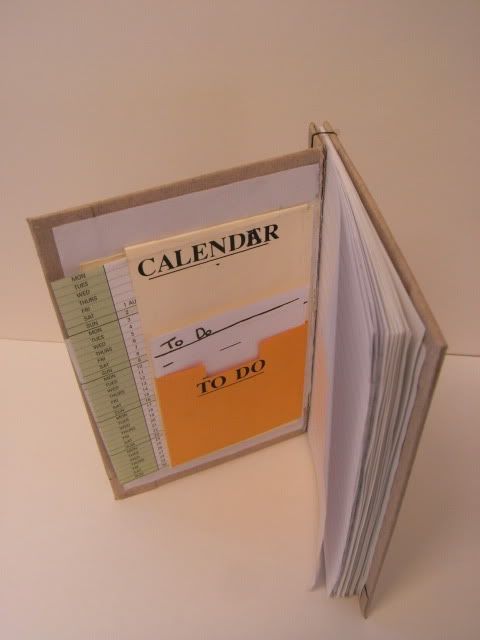
At this moment in time, the idea may be too hard to follow through, as time management may become a great factor considering the amount I would have to design, and the quality of the design. Lets see how the crit goes tomorrow.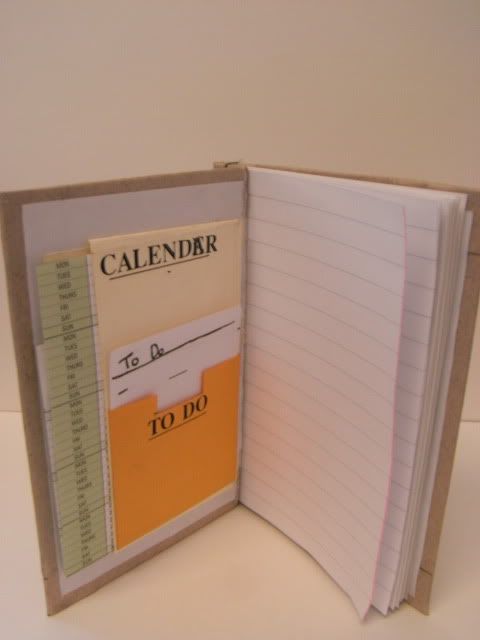

At this moment in time, the idea may be too hard to follow through, as time management may become a great factor considering the amount I would have to design, and the quality of the design. Lets see how the crit goes tomorrow.

Wednesday, 13 May 2009
PHASE 3:// [SFE]: Looking at nets
Since I was going to explore the idea of some form of interactive papertoy, that could be used for practical purposes, I decided to check out a really schweet site that Hannah gave me to check out paperforest.blogspot.com, which has a plethora of fun things to look at.
I was looking at the work of Alexander Marshall, as his nets were simple to follow, and had potential for a dispenser,or some other form of note that could be applied to the net itself.

I wanted it to be something desirable, and relevant to the brief - obviously! - yet could be seen as something fun and visually engaging.
So I went on his website (PUT HERE) and dowloaded some nets to have a go at.
Here are the results, which means if I can do it, the first years can!
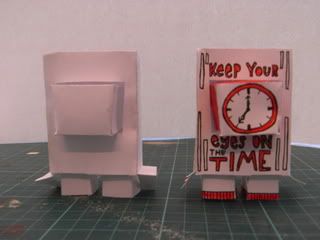
I was looking at the work of Alexander Marshall, as his nets were simple to follow, and had potential for a dispenser,or some other form of note that could be applied to the net itself.

I wanted it to be something desirable, and relevant to the brief - obviously! - yet could be seen as something fun and visually engaging.
So I went on his website (PUT HERE) and dowloaded some nets to have a go at.
Here are the results, which means if I can do it, the first years can!

PHASE 2: Speaking from experience
After the crit, it became apparent that some form of documentation device should be implemented into my designs.
Keeping all documentation of the day/week/month on oneself as it can be re-checked, re-evaluated and easy to access.
Using craft-based design was at thumbs up also, as the involvement of stock and good illustration would look rather fetching, considering my concept/idea for some sort of dispenser seemed a good idea to make it more engaging and interactive for the first year students.
On the other hand, I did not have any mocks to show at this point, which meant I would most probably have to generate some for future crits.
However, many people manage their time in their own way, so I had to run a survey as to find out who used what where and why, as this would most definitely determine the final content/outcome.
The questions I put forward in my survey were:
"How do you manage your time? (sketchbook,post-its, etc)"
"Do y ou think you can maintain a balance of work and 'play' on the course?"
"Are there any methods you could suggest that would make this easier?"
But before I got my results, I did some more ideas/visuals, as to establish a stronger basis for the outcome.
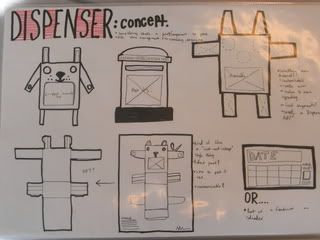
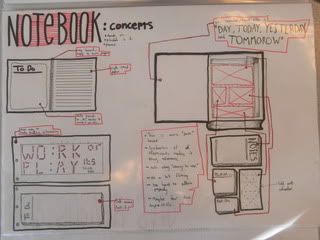
At the end of the crit, I had a little one-to-one with Amber and she suggested that since I generate scattered ideas, I should produce 10 possible resolutions to my problem, so I did. Sorry for the small picture, if you cant see it you can see it on my photobucket album.
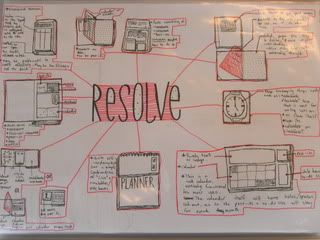
Keeping all documentation of the day/week/month on oneself as it can be re-checked, re-evaluated and easy to access.
Using craft-based design was at thumbs up also, as the involvement of stock and good illustration would look rather fetching, considering my concept/idea for some sort of dispenser seemed a good idea to make it more engaging and interactive for the first year students.
On the other hand, I did not have any mocks to show at this point, which meant I would most probably have to generate some for future crits.
However, many people manage their time in their own way, so I had to run a survey as to find out who used what where and why, as this would most definitely determine the final content/outcome.
The questions I put forward in my survey were:
"How do you manage your time? (sketchbook,post-its, etc)"
"Do y ou think you can maintain a balance of work and 'play' on the course?"
"Are there any methods you could suggest that would make this easier?"
But before I got my results, I did some more ideas/visuals, as to establish a stronger basis for the outcome.


At the end of the crit, I had a little one-to-one with Amber and she suggested that since I generate scattered ideas, I should produce 10 possible resolutions to my problem, so I did. Sorry for the small picture, if you cant see it you can see it on my photobucket album.

PHASE 1://Speaking from experience
So here we are the start of the brief. At first I wanted to tackle the problem of students not being critical enough about their work, and how to go about resolving it, but it was looking as promising as a pair of flip flops on Kilimanjaro, so I ditched it.
Instead I decided to tackle an obvious problem regarding time management and how the effective use of some braincells could benefit the students as much as a pair of walking boots would do for that mountain.
Reflective of myself, not being aware of deadlines, and in some cases not knowing what I needed to do, or how to go about it, resulted in unnessary stress and being too hyped up on coffee to make any sense whatsoever.
This is the first brainstorm I did from my folder, hence why the image is shiny.
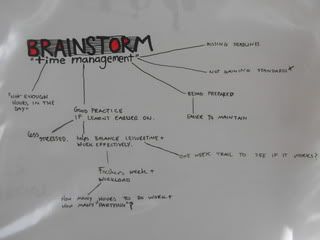
I was not aware that we were meant to be just in the research and pre-development stages, but I went ahead and did some concepts/ideas for possible solutions, despite it not even going to be a resolve at this stage, I still thought I would benefit from some form of visuals, as to give myself some boundaries/thoughts to speculate on.
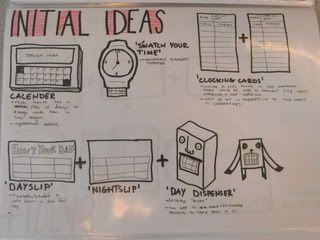
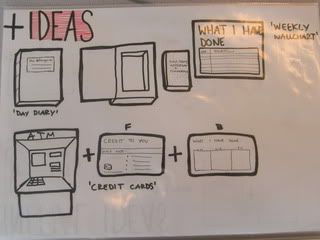
Instead I decided to tackle an obvious problem regarding time management and how the effective use of some braincells could benefit the students as much as a pair of walking boots would do for that mountain.
Reflective of myself, not being aware of deadlines, and in some cases not knowing what I needed to do, or how to go about it, resulted in unnessary stress and being too hyped up on coffee to make any sense whatsoever.
This is the first brainstorm I did from my folder, hence why the image is shiny.

I was not aware that we were meant to be just in the research and pre-development stages, but I went ahead and did some concepts/ideas for possible solutions, despite it not even going to be a resolve at this stage, I still thought I would benefit from some form of visuals, as to give myself some boundaries/thoughts to speculate on.


Manifestations of the first degree
Since September, I have developed a lot more as an individual, and also as a designer.
I had so many problems whirling around my head like an angry swarm of locusts seeking any morsel of food, be it flesh or grain.
Having a personal life as stable as a loose saddle on a metaphorical horse greatly effected how I worked and my attitude to others that had to suffer my verbal onslaught on a day-to-day basis, and a defensive stature on ANY form of criticism.
On top of this, I was sickeningly outgoing, and still am, but did not take anyone into consideration in conversation, bringing in the classic phrase of "think before you speak"
Taking my design skills into consideration, I had not much knowledge in software, and the level of sophistication required to pull off decent design effectively, but having some experience in craft-based skills/design, I was happy to expand on those skills.
Despite Fred saying that we cant rely on our comfort zones, I think I have learnt alot more in the formal aspects of design when using software, and warming towards the ease of production when using it. As the year progressed, I had the workshops which greatly benefitted me in my personal development, as I have become more proficient it to my own work.
However, my work ethic at the start was in doubt, due to my feeling out of place, that I was well in over my head, despite my mates on the course reassuring me that I was doing well, it still felt like I could benefit so much more by learning more skills then taking on this degree, as to develop myself more as an individual, but now I know that from the support of the tutors (not being a tutors pet here but-!) and also the others on my course, I feel as if I can achieve so much more.
My attitude towards work was slack, confused and scatter-brained, ALL THE TIME. This was greatly affected by my shit time management, and not knowing what was going on ALL THE TIME, factors of my personal life aside, it was hard for me to come to terms with who I was to become as a designer and as an individual.
Looking to the future, I still have far far far too much to learn, and much more to overcome in the coming year. (I am still terrible with finance, ask anyone at all, even Amber who is reading this will know that too, so I will leave that as an obvious statement.)
I would like to develop my crafting skills much more, as to get to the standard of Amand and Dean in the second year,but that drives me even more to be better and more involved with projects, even if I have not that much motivation or passion for, I still think I can get hands on and hammer down, even if it means a few all-nighters.
In terms of digital knowledge in all aspects of software they all need developing and they will in time, and as the year progresses as it is always a learning curve for me.
I now accept criticism with a pinch of salt, and am eager to hear what people think of what I am working on.
Overall, I have as much to learn as a baby does in growing into a full adult, but as the saying goes "crawl before you walk"
I am enjoying myself and the company I am in, which drives me alone to be better, I have alot of eating to catch up on (ha-ha...!) and alot of sleep - but that can wait until the brief is done.
I have also learnt that its best to make informed decisions otherwise my work ends up like a Kurt Cobain.
Lets see how far the rabbit hole goes......
Friday, 1 May 2009
Influence and inspiration
For this brief, the focus of self-reflection and becoming to know ourselves in the design world has tied in well with what the outcome will be. By using our own personal inspirations, we are to implement them into our work, as to show our own professional, personal development.
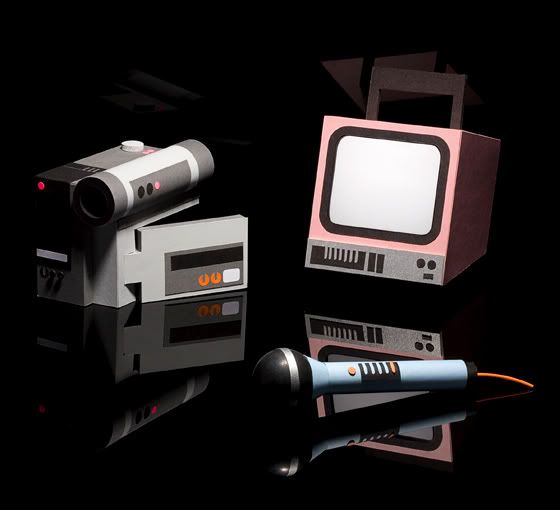
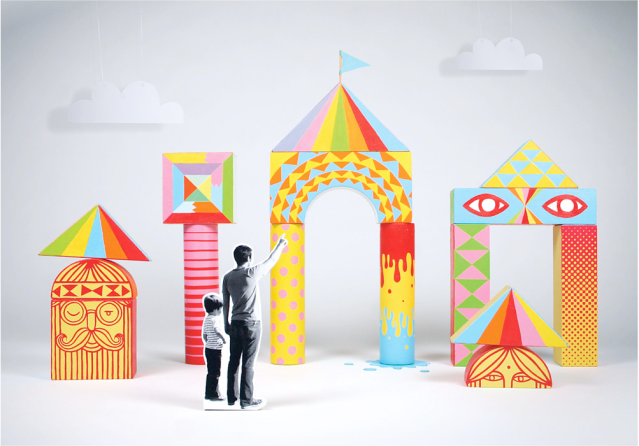
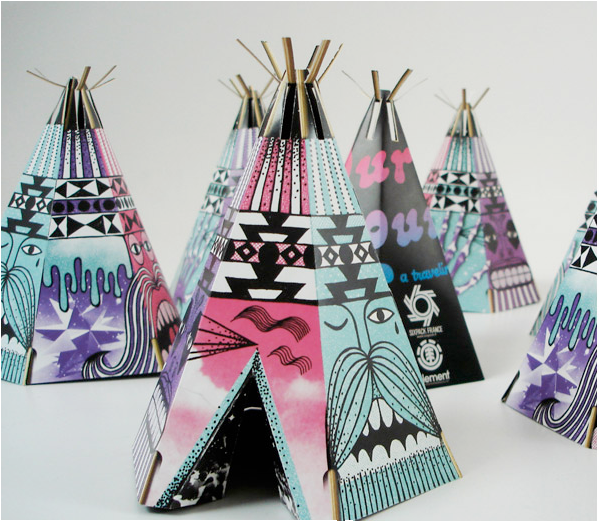
I wanted to have some sort of craft-based design to my work, as I feel I have not yet had the chance to fully exploit these skills. I noticed that 2 of the second years I talk to on a head-nodding, "hows it going" level - were into image by means of the "tactile" approach to design, so utilizing that big organ in between my nose and eyes, I asked them if they knew any designers that use craft as a basis for their work.
One of my ideas I had was that by creating some sort of dispenser, or clocking device, students could use it as a place to collect "clocking cards" or something along those lines, to document their day. Obviously more research is needed before I start this, however it may come to fruition, and I thought that by looking at designers such as Chrissie


Re-proposing my first year experience
It became apparent that my previous idea of trying to help first year students to be more critical in their approach to work would be very hard, or in my opinion, very boring to do well visually. It also limited my ideas and confused myself into a scattered and unfocused concept.
So I decided to tackle a huge problem that still plagues the rest of the course and not just us, and the soon to be first years - TIME MANAGEMENT.
I chose this as I think it would be more beneficial to learn about time management from day one, rather than a third of the way through the course, as not only is it a professional practice, but if facilitated correctly, it can bring a balance to the new lifestyle that awaits them.
THE PROBLEM IS:
First year students may not be organised enough to appreciate the balance of work and play.
I AM GOING TO DO THIS ABOUT IT:
I will be informing the first years that by organizing/planning their time more effectively, they will not get swamped with work and reap the rewards from their efforts.
I AM GOING TO DO THIS ABOUT IT:
I aim to create an interactive, engaging and fun approach to managing time that can be transported from place to place by the student, is easy to access, and is easy to fill in, but does not feel like a chore.
I will be using a combination of type and image to communicate this, as without the combination of the two, I dont think it will be done to a standard of visual impact.
Starting to speak from experience
After much discussion, debate, serious reflection and deliberation about the experience of being a first year and what I had learnt during my rocky baby steps to being a pro designer, it came to light that these were some of the main issues I found that had some significace to my ever growing curve of education.
These were narrowed down from what was a list of non-specific, or loosely based componenets of a phrase, or rather bits and pieces of a bigger problem. I chose to be more towards real reflection of myself, and to make it more informed to the first years, as I spent alot of it confused, disorganised and uninformed in my ability to make decisions.
So to put some focus into how I am actually going to address/approach this brief, here is my proposal, or rather my first proposal of ideas.
What is the problem?
People are not objective/critical enough about their work.
What am I going to do about this?
Warn them about the potential dangers of not achieving the standard for a resolution or their work in general, inform them of the positives of evaluating and making informed decisions when working, and to advise them about choosing a suitable method to achieve this.
How am I going to do it?
To produce some form of introduction pack to help the first years to document, evaluate and learn tips on how to be more critical, so some form of calender with designers on each month that encourages them to be more independent with their studies, with a do it yourself style booklet that is pocket sized and easy to write in, along with a top tips book that has reference to aid the first year in making decisions.
Or possibly some form of blog/website that has all the information archived in it for eas of access that may be useful, especially when they have to keep a blog.
But obviously there is alot more research and idea generation to go before I start to do anything.
1. Be prepared to make mistakes
2. Manage finances effectively
3."Dont polish a turd" - if its a bad idea, drop it!
4. READ THE BRIEF, READ THE BRIEF AND READ THE BRIEF
5. All nighter? All righty!
2. Manage finances effectively
3."Dont polish a turd" - if its a bad idea, drop it!
4. READ THE BRIEF, READ THE BRIEF AND READ THE BRIEF
5. All nighter? All righty!
These were narrowed down from what was a list of non-specific, or loosely based componenets of a phrase, or rather bits and pieces of a bigger problem. I chose to be more towards real reflection of myself, and to make it more informed to the first years, as I spent alot of it confused, disorganised and uninformed in my ability to make decisions.
So to put some focus into how I am actually going to address/approach this brief, here is my proposal, or rather my first proposal of ideas.
What is the problem?
People are not objective/critical enough about their work.
What am I going to do about this?
Warn them about the potential dangers of not achieving the standard for a resolution or their work in general, inform them of the positives of evaluating and making informed decisions when working, and to advise them about choosing a suitable method to achieve this.
How am I going to do it?
To produce some form of introduction pack to help the first years to document, evaluate and learn tips on how to be more critical, so some form of calender with designers on each month that encourages them to be more independent with their studies, with a do it yourself style booklet that is pocket sized and easy to write in, along with a top tips book that has reference to aid the first year in making decisions.
Or possibly some form of blog/website that has all the information archived in it for eas of access that may be useful, especially when they have to keep a blog.
But obviously there is alot more research and idea generation to go before I start to do anything.
Monday, 23 March 2009
Collaboration Communicational Virus: Our Pitch
We had a focus, we lost it, and despite our flurry of thoughts and misconstrued design process, we were struggling to get a main focus for our target audience.Soley relying on the current market for the DS was'nt such a good idea, as there are specific requirements to certain readers and I dont think we "hit the nail on the head" so-to-speak.


At this stage we were pitching to a panel of judges/peers to see if our idea would be worth investing in. We got good feedback, it became clear though that the message and the audience had been overlooked somewhat.
These are the A2 presentation boards we used to help clarify our pitch, unfortunately, I think we let ourselves down with poor design concepts, but our presentation was professionally done.
Its all trail and erro, trail ad Err, Trail and Error.
Collaboration Communicational Virus: Our Brief
Task: Getting People To Read More
The Brief:
To promote reading in conjunction with World Book Day via means of the Nintendo DS. It focuses on commuters who like to read on their journeys and how they can benefit from owning these products.
There is a pre-existing book feature for the console, is there space for more? Or will the book feature itself be enough to promote itself?
Concept/Proposal
The age old foundations of our linguistic development lie in books and what has been recorded in them. How can this be put into an engaging 21st century context?
Tone of Voice
Friendly, inviting and nothing to controversial, as the audience is broad and you need to captivate the existing market that Nintendo have.
Deliverables
Posters, flyer's in the public domain that is relevant to the brief. Mock promotional skins that would persuade the consumer to buy the book feature.
Considerations
Limited to 3 colours, however one of these colours must be stock. (red, black and white.)
What do the commuters see everyday and where will they go? You need to make sure that they are captivated or inspired by what they see and what they are going to buy is worthwhile.
You should consider how World Book Day promote themselves and see how you can tie it in with pre-existing promotional methods. Do it need improving? Are there other ways that this can be achieved?
The message need to include both type and image, as they are fundamental in selling what you will be saying.
Do you need they product on view? Or will use of differnt imagery benefit?
Mandatory Requirements
Keep it legal, you don't want to get arrested and not see your ideas bloom.
The Brief:
To promote reading in conjunction with World Book Day via means of the Nintendo DS. It focuses on commuters who like to read on their journeys and how they can benefit from owning these products.
There is a pre-existing book feature for the console, is there space for more? Or will the book feature itself be enough to promote itself?
Concept/Proposal
The age old foundations of our linguistic development lie in books and what has been recorded in them. How can this be put into an engaging 21st century context?
Tone of Voice
Friendly, inviting and nothing to controversial, as the audience is broad and you need to captivate the existing market that Nintendo have.
Deliverables
Posters, flyer's in the public domain that is relevant to the brief. Mock promotional skins that would persuade the consumer to buy the book feature.
Considerations
Limited to 3 colours, however one of these colours must be stock. (red, black and white.)
What do the commuters see everyday and where will they go? You need to make sure that they are captivated or inspired by what they see and what they are going to buy is worthwhile.
You should consider how World Book Day promote themselves and see how you can tie it in with pre-existing promotional methods. Do it need improving? Are there other ways that this can be achieved?
The message need to include both type and image, as they are fundamental in selling what you will be saying.
Do you need they product on view? Or will use of differnt imagery benefit?
Mandatory Requirements
Keep it legal, you don't want to get arrested and not see your ideas bloom.
Thursday, 19 March 2009
Collaboration Communicational Virus: The Start
The Brief is...
"Communication is a virus, how does it spread?"
New brief and this time it's a collaboration.
My partner in crime is Leigh
She needed someone with good idea generation and whose handwriting was on some level of readability. I needed someone who was more tech savvy than me and who can focus on something and stick to it.
No matter if we are both chatterboxes and our personal ads in no way represented us entirely, it gave the other some insight to what we were good at.
Task: To get people to read more.
Tom: Because I like reading and I think people lose alot from not doing so.
Leigh: I enjoy reading more so that watching TV. In my opinion, more people should do it!
Leigh: Decent book design (badly designed irritates me, Anita Blake prime example.) Actual content, writing, fandoms.
Tom: Crafting, concept spooling, ideas, researcher
Leigh: Illustration, layouts, knowledge of software
Tom: Concepts and Idea generation, good with rhymes & writing, research
Leigh: Good Imagination, concepts, idea generation, humour
Tom: researcher, concept and idea generator, crafting
Leigh: software, concepts, layout, type, illustration
Tom: researcher, concept artist
Leigh: Concept artist, layouts.
What will you joint responsibility's be?
Discussing concepts and where we are going with it. Evaluation and statement of itent, visual, development, crits and blogs.
Lets crack on down to designertown.
"Communication is a virus, how does it spread?"
New brief and this time it's a collaboration.
My partner in crime is Leigh
She needed someone with good idea generation and whose handwriting was on some level of readability. I needed someone who was more tech savvy than me and who can focus on something and stick to it.
No matter if we are both chatterboxes and our personal ads in no way represented us entirely, it gave the other some insight to what we were good at.
So we looked at the available viruses to issue and through a process of elimination, we came to a conclusion that we both felt strongly on the topic of reading and that people indeed should read more, as it something we feel should be raised awareness of.
Task: To get people to read more.
Why have you chosen this task?
Leigh: I enjoy reading more so that watching TV. In my opinion, more people should do it!
What are my specific areas of creative interest in this task?
Tom: Book cover design, how to make books look cool, ads, type, content.
Leigh: Decent book design (badly designed irritates me, Anita Blake prime example.) Actual content, writing, fandoms.
What specific design skills do you have to offer in relation to your chosen task?
Leigh: Illustration, layouts, knowledge of software
What specific non-design skills do you have to offer in relation to your chosen task?
Leigh: Good Imagination, concepts, idea generation, humour
What will your specific roles be in the collaboration in the relation to your brief?
Leigh: software, concepts, layout, type, illustration
What will your individual responsibilities be in relation to your brief?
Tom: researcher, concept artist
Leigh: Concept artist, layouts.
What will you joint responsibility's be?
Discussing concepts and where we are going with it. Evaluation and statement of itent, visual, development, crits and blogs.
Lets crack on down to designertown.
Friday, 6 March 2009
RECOGNISE! Development.
Last week we got set a brief in which we had to choose to either design an A2 poster fordontpanic! or design an A6 concept exploring the ideal of "recognition."
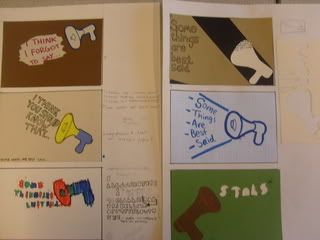
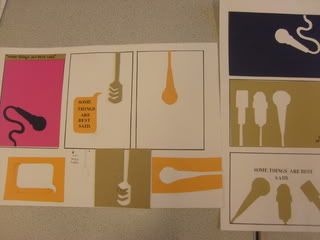
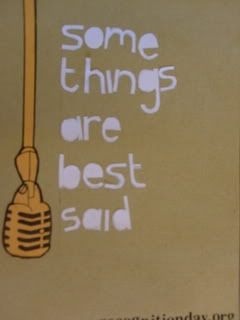
I chose to go with "recognition" as I had alot to connect with concerning this subject, as I felt not enough people are getting enough recognition for the things they do.
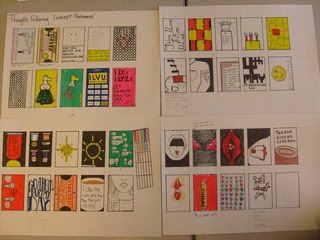
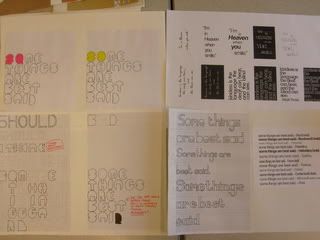
The following shows the development work I produced.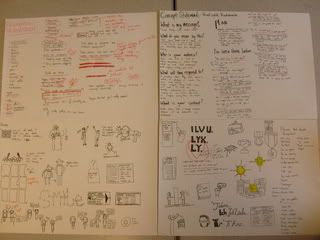
 >
>
I chose to go with "recognition" as I had alot to connect with concerning this subject, as I felt not enough people are getting enough recognition for the things they do.
The following shows the development work I produced.

 >
>


Subscribe to:
Comments (Atom)